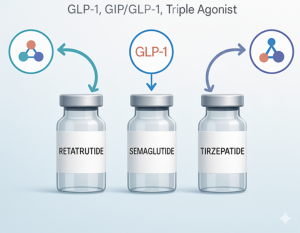
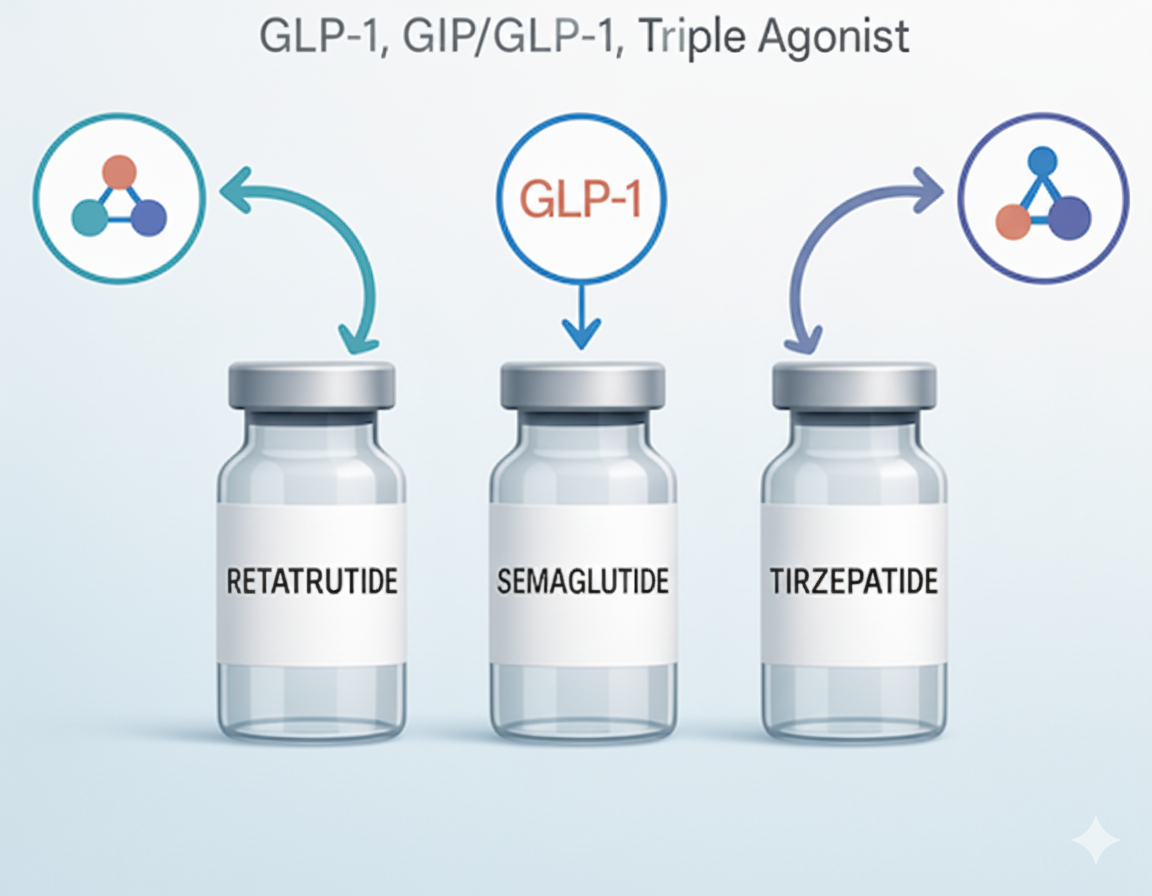
During the last decade, tremendous strides have been made in the fight against obesity, such as the advent of GLP-1 weight loss therapies. From Semaglutide to Tirzepatide, these peptides have revolutionised the approach to weight management. Now, however, researchers are focusing on an even newer and more powerful contender: Retatrutide.
The weight loss peptide Retatrutide is being dubbed as the most potent peptide of them all. What is unique about the peptide is that the weight loss research is evidenced to exceed all current therapies. Retatrutide is unlike older drugs, which act on one or two hormone receptors. Retatrutide is a triple agonist peptide: Retatrutide agonises GLP-1, GIP, and glucagon simultaneously. The more versatile pharmacodynamics of Retatrutide are likely responsible for the extraordinary weight loss seen in clinical research, with some subjects losing almost a quarter of their body weight.

In this article, we will cover how Retatrutide works, its clinical trial results, and its side effects as well as its potential in comparison with Semaglutide and Tirzepatide are discussed in this article. If Retatrutide is, as some posit, the future of obesity treatment, it is well worth reading about.
What Is Retatrutide?
So, what is Retatrutide? Retatrutide is an experimental drug being developed by Eli Lilly, one of the world’s leaders in metabolic research. It is described as a GLP-1, GIP, and glucagon receptor triple agonist. This means that, in contrast to the current peptides and medications that only activate one or two pathways, Retatrutide peptide activates three, thus making it a one-of-a-kind therapy in weight management.
Let us try to analyse its mechanism of action.
- GLP-1 (glucagon-like peptide 1): Inhibits appetite and stimulates insulin secretion and digestive processes at different rates.
- GIP (glucose-dependent insulinotropic polypeptide): Augments the appetite and insulin storage.
- Glucagon receptor stimulation: Facilitates the combustion of fats as well as the output of energy.
GIP, GLP-1 and glucagon receptor agonists create a synergistic effect to mimic what natural peptides do. Still, in addition to suppressing appetite, Retatrutide offers unparalleled appetite control and energy expenditure boosting, a far more comprehensive approach to weight management.

This is the triple-agonist feature that draws attention to Retatrutide as opposed to GLP-1 or dual agonist drugs. For people suffering from obesity, this may mean much better and lasting outcomes.
Looking for high-quality research peptides like Retatrutide? Explore our trusted collection at Adaptog Research today.
Retatrutide and Weight Loss Results from Clinical Trials
There is a high level of enthusiasm surrounding retatrutide, which is entirely warranted in view of outcomes in retatrutide clinical trials. Researchers noted retention clinical studies in the Phase II stage of the trials, where the achievement level in weight loss was above and beyond their expectations.
- In the course of the trial, those on the highest dosage of Retatrutide actually achieved weight loss of 24% in 48 weeks.
- Semaglutide results in a 10 to 15% weight loss
- While Tirzepatide does 15 to 20%, the results from retatrutide studies have clearly shattered that 24% achieved, and it is a record.
Such results are highly indicative of Retatrutide being a next-level treatment for obesity, and perhaps, even more invasive forms of surgery for weight loss therapy, which have also less effectiveness.
In addition to weight loss, trials showed significant improvement in other metabolic parameters, including blood glucose levels, blood cholesterol, and blood pressure. Thus, Retatrutide has the dual action of helping to lose weight while improving health in the long term.
There is a high level of optimism and focus on whether Retatrutide is the most effective peptide to be studied in obesity research so far, which is well-founded, given the evidence we have.
Retatrutide vs Semaglutide vs Tirzepatide
Innovation has been prevalent in the development of weight loss peptides, with every new therapy being an extension of the previous ones in their merits and drawbacks. The original indication that the GLP-1 receptor could be targeted to achieve significant weight loss was made when Semaglutide was first used as a glucose-controlling drug.
Tirzepatide subsequently took the field to another next level by integrating GLP-1 and GIP receptor stimulation, which produced even greater clinical research results. Retatrutide, a triple agonist peptide, is now bringing the bar even higher since it adds the concept of glucagon receptor activation to the equation. When looking at retatrutide vs semaglutide and tirzepatide vs retatrutide, the differences become clear. Each therapy represents a step forward in weight loss innovation.
Semaglutide:
As a GLP-1 agonist, Semaglutide decreases appetite as well as improves glycemic control. Also, it was approved by the FDA for the treatment of obesity under the brand name Wegovy. At this level, the average weight loss was 10-15% of a person’s starting weight.
Tirzepatide:
As a dual agonist, Tirzepatide activates both GLP-1 and GIP receptors. Therefore, it provides more potent effects than Semaglutide. The average weight loss with this agent is 15–20%.
Retatrutide:
As a triple agonist peptide, Retatrutide activates GLP-1, GIP and glucagon receptors. Its wider range offers better appetite control and swallowing, as well as promoting weight loss. In early trials, the average weight loss was up to 24%.
| Therapy | Mechanism of Action | Average Weight Loss (1 Year) | Status |
| Semaglutide | GLP-1 receptor agonist | 10–15% | FDA-approved |
| Tirzepatide | GLP-1 + GIP dual agonist | 15–20% | FDA-approved |
| Retatrutide | GLP-1 + GIP + glucagon triple agonist | Up to 24% | Phase II trials |
This comparison shows why GLP-1 vs triple agonist discussions are heating up. If Phase III trials confirm the early results, Retatrutide could take centre stage as the most effective option for obesity treatment.
Potential Side Effects and Safety Profile
Retatrutide safety is still under review. Because it is only in Phase II trials, long-term data on liver health, cardiovascular safety, and rare complications are not yet available. This highlights the importance of medical supervision and why Retatrutide remains strictly a research peptide at this stage.
Needless to say, there is no risk-free medication. Recent reports indicate that retatrutide side effects are primarily similar to Semaglutide and Tirzepatide.

Common side effects:
- Nausea
- Vomiting
- Diarrhoea or constipation
- Abdominal discomfort
Comparisons:
- The most frequent complaint with Semaglutide side effects is gastrointestinal discomfort.
- Tirzepatide side effects also cause Tirzepatide patients to complain of nausea and digestive dysfunctions, particularly when the drug is being escalated.
- In some cases, retatrutide is observed to induce a progressively milder initial nausea, probably because it has a wider activator receptor.
The safety of retatrutide is yet to be reviewed. Due to its Phase II trials, the long-term data on liver health, cardiovascular safety, and uncommon complications are not available yet. This supports the need to medically oversee and why Retatrutide is still a research peptide.
The Future of Retatrutide in Weight Loss Research
The future of Retatrutide is perfect. Provided that Phase III clinical trials prove that Retatrutide is safe and effective, it may be approved by the FDA in several years. Its success would hugely enlarge the pipeline of drugs to treat obesity, providing an alternative to the currently available treatments for patients.
Analysts believe Retatrutide can redefine the market of GLP-1 and is even likely to do better in efficacy than both Semaglutide and Tirzepatide. Should it be allowed, it can be the new weight loss peptide, particularly for patients who need more drastic outcomes.
Adaptog provides premium life sciences solutions, including Retatrutide, Semaglutide, and Tirzepatide research peptides. Visit Adaptog to explore today.
FAQs
Is Retatrutide FDA-approved for weight loss?
No, Retatrutide is not approved by the FDA yet. But it’s still in the clinical trials process, although approval can take many more years to come.
How does Retatrutide compare to Semaglutide and Tirzepatide?
Retatrutide vs Tirzepatide shows stronger weight loss outcomes in early trials, while retatrutide vs semaglutide demonstrates almost double the results. Its triple agonist mechanism gives it an edge.
What are the potential side effects of Retatrutide?
The most common side effects are digestive problems, nausea, and vomiting.
Can I buy Retatrutide online?
Currently, it is only available for research purposes. If you want to study retatrutide buy online, trusted suppliers like Adaptog Research provide access to high-quality research-grade peptides.
Is Retatrutide the most potent weight loss peptide so far?
Yes, current data suggest Retatrutide shows the most significant weight loss potential among GLP-1 and dual agonist drugs. Patients in trials lost up to 24% of their body weight.
What makes Retatrutide different from other GLP-1 injections for obesity?
It’s a triple agonist peptide mechanism that has better insulin sensitivity, increased fat burning and appetite suppression. This multi-target approach makes it more comprehensive than existing treatments.
Conclusion
Retatrutide is proving to be a new icon in the treatment of obesity. Through its triple agonist peptide properties, it is already providing weight loss results that the existing GLP-1 agonist drugs cannot provide. Although further studies are required to prove the retatrutide safety, its ability to be the most potent weight loss peptide is challenging to overlook.
Retatrutide is not only another drug on the pipeline but an opportunity to revolutionise the future of obesity care for the researchers and healthcare professionals.
Stay ahead in life sciences research. Order Retatrutide, Semaglutide, and Tirzepatide today at Adaptog.